


The Cognitive Architecture of Autonomous Cranes
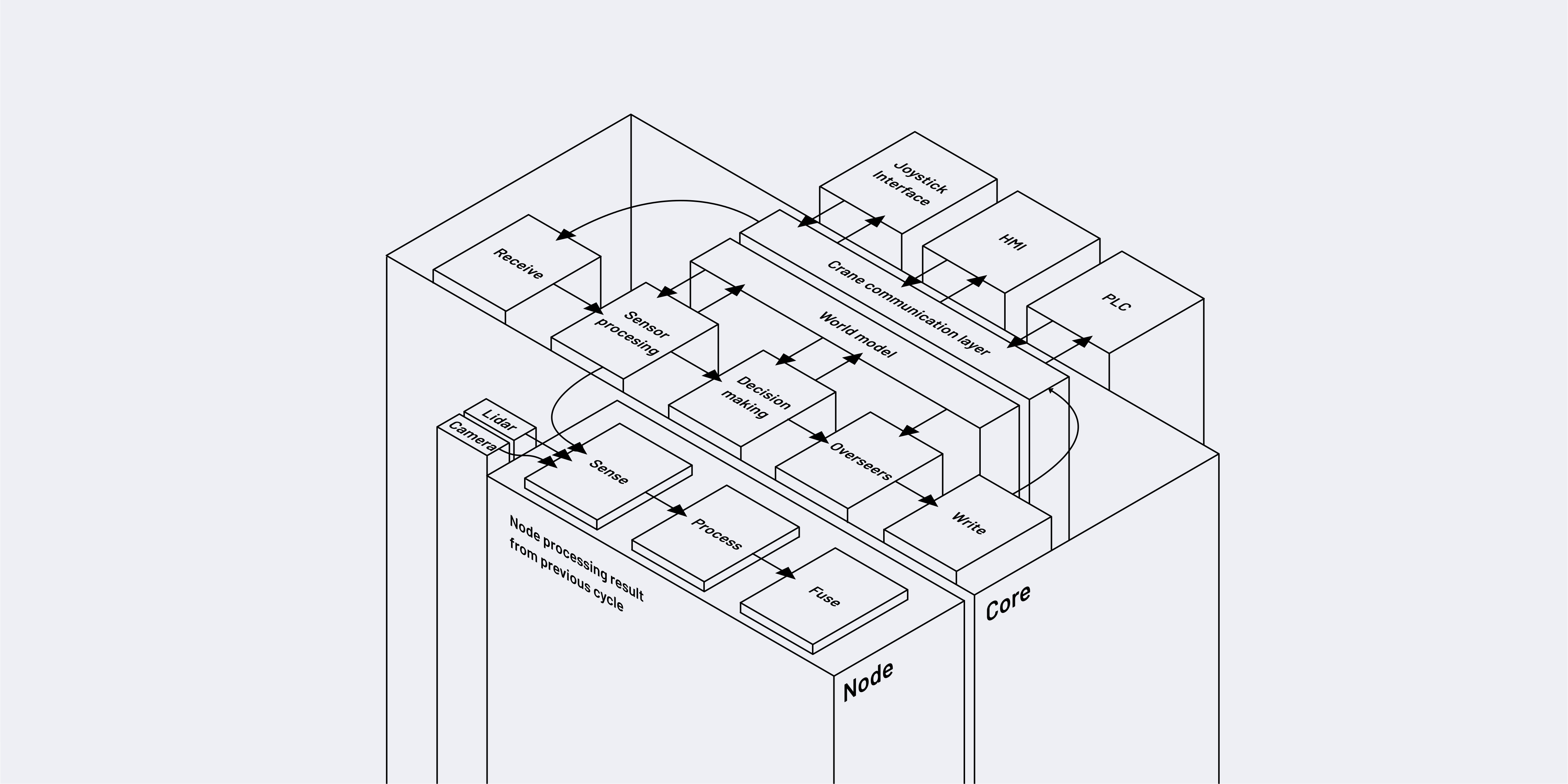
Belief: The World Model
AutoCrane features a central, predictive world model in which knowledge (“belief”) about the system’s own state and its environment is collected, filtered, integrated, and continuously updated (predicted) in a coherent manner.
Desire: The Goal
A higher-level deliberative layer makes fundamental decisions regarding the current goal to be pursued (“Desire”), such as “Take up a waiting position” or “Unload the truck.” Within AutoCrane, this level is implemented as a finite state machine whose states represent the customer’s process steps. The transitions are based on simple predicate logic rules that are fed by information from the world model.
External commands—whether from the crane operator or a higher-level system control—are recorded as “external requests” and processed at this level.
AutoCrane then breaks down the current target into intermediate steps and finally into specific actions—all the way down to the control commands for the crane’s individual axes. This part of the decision-making and control process is implemented based on a hierarchical, behavior-based architecture.
Intent: Behavior
Individual behaviors, such as “open grapple,” “grab logs,” or “approach load” have specific preconditions, constraints, and postconditions. These are recursively nested into complex strategies and use only two different arbitration methods: priority lists and sequences.
These methods select the specific action to be performed (“intent”) based on the current (interim) goal, the state of the world model, and the preconditions and constraints. The selected action then calculates the specific control command to be sent to the crane.
Deliberation, Decision-Making, and Definition of Instructions
Unlike in traditional planning approaches, the decision regarding the current (intermediate) goal is not made at long intervals and then carried out over extended periods of time, but rather takes place in each individual cycle. This enables the AI to respond immediately to changes in the system state or the environment.
Central processing and command generation within AutoCrane are organized sequentially and synchronously, similar to a classic control loop: Sensor data is processed, integrated into the world model, and then, based on the current goal, a decision regarding the specific action to be performed is generated and formulated into a control command.
AutoCrane currently runs through this central cycle in the main software with a cycle time of 50 ms.
World Model
The world model includes a "transformation tree"—a kinematic method borrowed from robotics (forward and inverse kinematics). This tree describes the relationships between all of the crane's joints and components, as well as the connected sensors, and is continuously updated in real time as the crane moves.
The transformation tree allows us to transform coordinates from the reference frame of any sensor or joint into any other reference frame. This makes it easy to convert measured joint angles into a position in Cartesian coordinates—or, conversely, to convert a target position in Cartesian coordinates into the corresponding position and motion in joint space (axis coordinates).
Safety
Every command calculated by AutoCrane is checked for any potentially unsafe behavior before it is transmitted to the crane’s PLC (Programmable Logic Controller). To do this, AutoCrane uses a simplex architecture commonly found in safety technology: A safety monitor (“Safety Overseer”) monitors the output and intervenes immediately if simple rules are violated. It modifies the system output to ensure the safest possible state at all times.

Volker Voss
Managing Director Sales
Learn More about Industrial AI for Your Crane
Would you like to know more about our autonomous crane? Contact our sales manager directly. Please send us your questions using the button below. We’ll get in touch to schedule a personal consultation, during which we’ll discuss how our Industrial AI can lighten the load on your employees and support your bottom line.